Papua Wildlife Photography Tour: Telephoto, Hides & Cendrawasih Display Sites with Birds of Paradise Indonesia
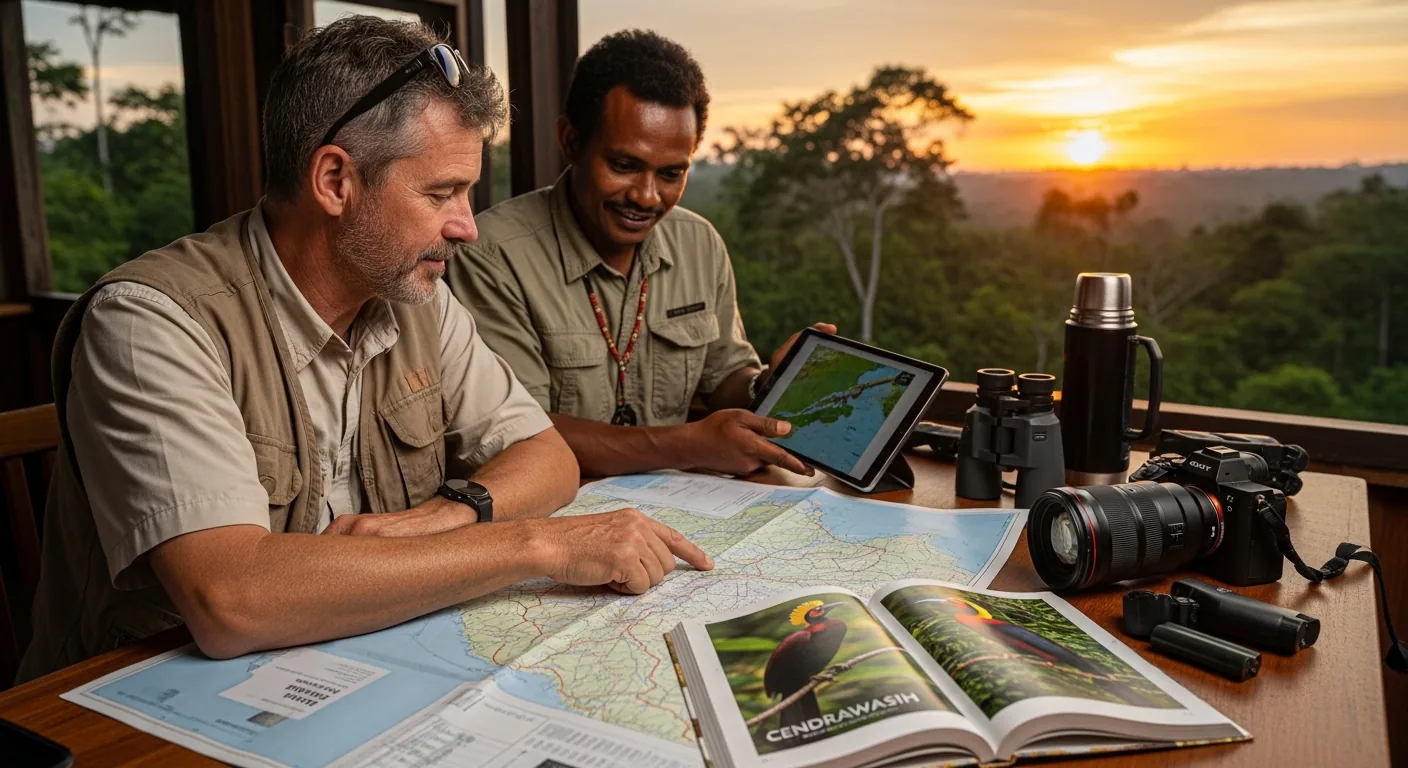
The air in the Arfak Mountains, 1,600 meters above the Celebes Sea, is thin and carries the scent of wet earth and decaying foliage. It is 04:30. Long before the sun touches the canopy, you are situated inside a palm-thatched hide, a simple but effective blind overlooking a meticulously cleared patch of forest floor. The silence is not an absence of sound, but a layering of it—the hum of insects, the distant call of a Papuan Frogmouth, the rustle of unseen mammals. Your 600mm lens rests on its gimbal, pointed towards the display court, or lek. Then, a new sound cuts through the pre-dawn chorus. A sharp, metallic call. A flash of iridescent bronze and cobalt blue signals the arrival of the Western Parotia. The performance, a ritual perfected over millennia, is about to begin. This is the singular focus of a photographic expedition in West Papua: to witness and frame the enigmatic cendrawasih, the birds-of-paradise.
The Photographer’s Pursuit: Framing the Birds-of-Paradise
Photographing the 39 known species of the Paradisaeidae family is a discipline of patience, technical precision, and profound local knowledge. These are not birds you happen upon; they are creatures of specific altitudes, territories, and ritual. Capturing a compelling image—the fanned plumes of a Red Bird-of-Paradise against the dark green of the Waigeo Island jungle, or the kaleidoscopic crown of a Wilson’s Bird-of-paradise as it clears its display court—requires more than just photographic skill. It requires being in the precise location at the exact right moment, a feat achieved only through deep collaboration with the indigenous communities who are the ancestral guardians of these forests. See also: Birds of Paradise Indonesia Expeditions Home.
A successful cendrawasih bird papua expedition is built around the rhythms of the birds themselves. The day begins hours before sunrise to reach the hides before the male birds arrive for their morning displays. The treks can be demanding, following narrow, often muddy footpaths through dense montane forest. The reward is an opportunity to document behaviors few will ever witness firsthand. Our expeditions are designed by photographers, for photographers. We understand that success is measured not in species ticked off a list, but in the quality of the encounters and the resulting portfolio of images. We focus on providing sustained access to key species in prime habitats, from the high-altitude forests of the Arfak Mountains to the lowland rainforests of the Raja Ampat archipelago.
Our philosophy is one of minimal disturbance. The hides, constructed by the Sougb and Hatam communities, are positioned over months to habituate the birds, ensuring the natural behavior you capture is not a reaction to your presence. See also: book Contact.
Expedition Inclusions: A Framework for Photographic Success
A seamless logistical foundation is critical for a productive photographic tour in a region as remote as West Papua. Our expeditions are structured to handle every detail, allowing you to focus entirely on your craft. Each itinerary with Birds of Paradise Indonesia Expeditions is comprehensive. See also: the ampat bird tour option.
- Private, Purpose-Built Photography Hides: Strategically located at active leks and display courts for species like the Western Parotia, Magnificent Bird-of-Paradise, and Wilson’s Bird-of-Paradise.
- Expert Ornithological & Local Guides: Your expedition is led by guides with specialized knowledge of avian behavior, photographic techniques, and deep-rooted connections to the local communities of West Papua.
- All-Inclusive Ground Logistics: This includes private 4×4 vehicle transport for mountain access, domestic flights (e.g., Sorong to Manokwari), and chartered speedboats for island transfers in Raja Ampat.
- Specialized Accommodations: We utilize a network of dedicated eco-lodges and basic, clean field camps, chosen for their direct proximity to primary birding areas, minimizing daily travel time.
- All Necessary Permits: We secure and manage all required travel documentation, including the Surat Jalan (travel permit for interior Papua) and national park entry fees.
A Sample Itinerary: The Arfak Mountains & Raja Ampat Photographic Focus (14 Days)
This itinerary represents a classic combination for photographers, targeting the montane specialists of the Arfaks and the iconic lowland species of the Raja Ampat islands. It is a journey of altitude and adaptation. See also: the bop species guide option.
Days 1-2: Arrival and Ascent to the Arfaks
Arrive at Sorong’s Domine Eduard Osok Airport (SOQ), where you will be met by your guide. You’ll take a connecting domestic flight to Manokwari (MKW). Upon arrival in Manokwari, the capital of West Papua province, you will transfer to a 4×4 vehicle for the 3-4 hour drive up into the Arfak Mountains, climbing to our base at an elevation of approximately 1,600 meters near the village of Siyoubri. Settle into the basic but comfortable mountain lodge.
Days 3-6: Arfak Mountains Birding Photography
These days are dedicated to intensive arfak mountains birding photography. The routine is rigorous. Wake-up call at 04:00 for a simple breakfast, followed by a pre-dawn trek (30-90 minutes) to the hides. Mornings are spent focusing on the lekking displays of the Western Parotia (Parotia sefilata), Vogelkop Superb Bird-of-Paradise (Lophorina niedda), and Magnificent Bird-of-Paradise (Diphyllodes magnificus). Afternoons may be spent searching for other montane endemics or reviewing the day’s images.
Days 7-8: Transition to the Islands of Raja Ampat
After a final morning session in the Arfaks, we descend back to Manokwari and take the flight to Sorong. Overnight in Sorong to rest and prepare for the next leg. The following morning, we board a private speedboat for the 2-hour crossing to Waigeo, the largest of the four main islands in the Raja Ampat archipelago. We check into our jungle resort, the base for our lowland rainforest exploration.
Days 9-12: The Pursuit of Wilson’s and Red Birds-of-Paradise
The focus of our raja ampat bird tour is on two of the most visually striking birds on the planet. Mornings are dedicated to the Wilson’s Bird-of-Paradise (Cicinnurus respublica). This involves another pre-dawn start to reach the hide overlooking its display court, which the male bird meticulously clears each day. The unique challenge is capturing the iridescent blue of its bare crown. Other sessions will target the Red Bird-of-Paradise (Paradisaea rubra), known for its communal treetop displays and cascading crimson flank plumes.
Days 13-14: Return and Departure
After a final morning of photography on Waigeo, we will take the speedboat back to Sorong. You will have a day room available to sort equipment before being transferred to Domine Eduard Osok Airport (SOQ) for your onward flight.
Expedition Logistics and Photographic Considerations
Choosing the right expedition depends on your target species and tolerance for rugged conditions. While the Arfak Mountains offer a higher concentration of Paradisaeidae species, the Aru Islands present a more demanding logistical challenge for unique endemics. Below is a comparison to help guide your decision.
| Feature | Arfak Mountains Focus (10 Days) | Arfak & Raja Ampat Combo (14 Days) |
|---|---|---|
| Primary Target Species | Western Parotia, Vogelkop Superb BoP, Magnificent BoP, Black Sicklebill | Includes all Arfak targets plus Wilson’s BoP and Red BoP |
| Terrain & Altitude | Montane rainforest, 1,400-2,000 meters. Steep, muddy trails. | Montane forest and lowland tropical rainforest at sea level. |
| Physicality Level | Challenging. Requires good fitness for daily pre-dawn hikes on uneven ground. | Challenging in Arfaks, Moderate in Raja Ampat. Overall demanding. |
| Best Season | The drier season, typically May through October. | The drier season, typically May through October. |
| Photographic Style | Exclusively hide-based photography for lekking species. Low light conditions. | Hide-based in both locations. Raja Ampat offers slightly better light conditions. |
Recommended Photographic Equipment
Success in the low light of the rainforest canopy and floor depends heavily on your equipment. We strongly recommend the following:
- A primary camera body with excellent high-ISO performance (e.g., ISO 3200-12800).
- A long telephoto prime lens (400mm f/2.8, 500mm f/4, or 600mm f/4) is essential.
- A sturdy tripod with a gimbal or fluid video head for stability and smooth tracking in the hides.
- Multiple batteries and memory cards, as charging opportunities can be limited in field camps.
- Comprehensive rain protection for all your gear, including lens hoods and camera covers.
Investment & Expedition Tiers
Our expeditions are meticulously planned and executed with a high guide-to-guest ratio to ensure a premium photographic experience. All tours are private and can be customized to your specific targets and schedule.
Private photographic expeditions start from $7,500 USD per person for a 10-day Arfak Mountains itinerary, based on double occupancy.
The final investment will vary based on several factors, including the total duration of the trip, the number of participants in your private group, the complexity of logistics (e.g., a charter flight for a wilson’s bird of paradise aru islands expedition), and any specific customizations. We provide a detailed, transparent quote with no hidden costs following our initial consultation. For a bespoke itinerary and quotation, please contact our expedition planning team at our Bali office.
Your Questions Answered: Preparing for a Cendrawasih Expedition
We’ve compiled answers to common questions to help you prepare for your journey to West Papua.
What is the best time of year to photograph birds-of-paradise?
The prime season is generally during the drier months, from May to October. This period offers more reliable weather, less challenging trail conditions, and coincides with the peak display activity for many species. That said, bird activity is present year-round, and trips can be successful in other months.
How physically demanding are the treks?
The treks should be considered moderate to challenging. You must be prepared for daily hikes of 1-3 hours each way, often starting before dawn. The trails are narrow, can be very muddy and slippery, and frequently involve steep ascents and descents. A solid level of cardiovascular fitness and stability is essential for both your safety and enjoyment.
What are the accommodations like?
Accommodations are selected for proximity to the wildlife, not for luxury. In the Arfak Mountains, expect simple, clean wooden guesthouses or field camps with basic bedding and shared bathroom facilities. In Raja Ampat, we typically use comfortable dive resorts or eco-lodges that offer a higher standard of amenity.
Is it possible to see Wilson’s Bird-of-paradise?
Yes, observing and photographing the Wilson’s Bird-of-paradise is a primary objective of our expeditions to Raja Ampat (Waigeo and Batanta islands) and, for the most dedicated, the Aru Islands. It is one of the most sought-after species, and our local guides maintain the hides at its display courts to provide reliable opportunities.
What permits are required for travel in West Papua?
A special travel permit, known locally as a Surat Jalan, is required for foreign visitors to travel to interior regions like the Arfak Mountains. Birds of Paradise Indonesia Expeditions handles the entire application and approval process for these permits on your behalf as an integral part of our service.
Can I combine a birding tour with diving in Raja Ampat?
Absolutely. We specialize in creating custom, dual-focus itineraries. A typical trip might involve a week of intensive birding followed by a week of diving or snorkeling in Raja Ampat, which holds the highest recorded marine biodiversity on Earth. We can arrange for seamless transitions between land-based birding and a liveaboard dive vessel or resort.
The Birds of Paradise Indonesia Expeditions Difference: Expertise & Ethics
What sets our expeditions apart is our deep-seated commitment to the region. Our lead guides are not seasonal hires; they are often from the local Hatam, Sougb, and Papuan communities, possessing generations of traditional ecological knowledge. This is augmented with formal training in ornithology, conservation principles, and the specific needs of professional wildlife photographers. When you travel with us, you are directly supporting a community-based conservation model. A significant portion of your expedition fee is channeled back to the local landowners and communities who protect these vital forest corridors, ensuring the cendrawasih have a future and that ecotourism provides a sustainable livelihood.
Securing Your Photographic Expedition
Our booking process is consultative and designed to create the ideal photographic journey for you. It involves four simple steps.
- Step 1: Initial Consultation. Contact our expedition specialists to discuss your photographic objectives, target species, physical fitness, and preferred travel dates. Reach us via email at [email protected] or by phone at +62 811 3941 4563.
- Step 2: Bespoke Itinerary Design. Based on our conversation, we will draft a detailed, day-by-day proposal and a transparent quotation for your private tour.
- Step 3: Confirmation & Preparation. Upon your approval, we will confirm all arrangements and begin the permit process. You will receive a comprehensive pre-departure package, including a detailed packing list, equipment recommendations, and cultural information.
- Step 4: The Expedition. You will be met by your guide upon arrival in West Papua, and your photographic exploration into the world of the birds-of-paradise will begin.
Our main office is located at: Birds of Paradise Indonesia Expeditions, Jalan Sunset Road No. 88, Kuta, Badung, Bali 80361, Indonesia.
Explore Further Expeditions in the Indonesian Archipelago
Our expertise extends beyond the classic West Papua routes. For returning clients or those with highly specific goals, we offer a range of specialized expeditions.
Ornithological Surveys in the Aru Islands
A logistically intensive expedition for researchers and dedicated birders targeting the remote Aru Islands endemics. This is the ultimate frontier for those seeking species like the Aru Sicklebill and the true King Bird-of-Paradise in its type locality, first documented by Alfred Russel Wallace in 1857.
Raja Ampat Birding & Marine Life
A perfectly balanced tour that combines a dedicated raja ampat bird tour on Waigeo with a private charter or resort stay to experience the world-renowned snorkeling and diving of the Coral Triangle’s epicenter.
The Deep Interior: Cendrawasih Bird Papua Expeditions
For the seasoned adventure traveler, we can facilitate treks into more remote mountain ranges and interior forests. These are challenging, exploratory trips designed in collaboration with clients who have advanced trekking experience and a desire to document some of the least-seen avifauna on the planet.
Related reading
- Predicting the 2027 Impact of Climate Change on Wilson's Bird-of-Paradise Foraging Habits
- The Lesser Sicklebill's Courtship Rituals: A 2027 Perspective on Vocal Mimicry and Female Choice
- Private vs. Group: Which Guided Bird of Paradise Indonesia Trip is Best?
- Press & Recognition — Birds of Paradise Indonesia Expeditions in the Media