Wilson’s Bird-of-Paradise Expedition: Raja Ampat with Birds of Paradise Indonesia
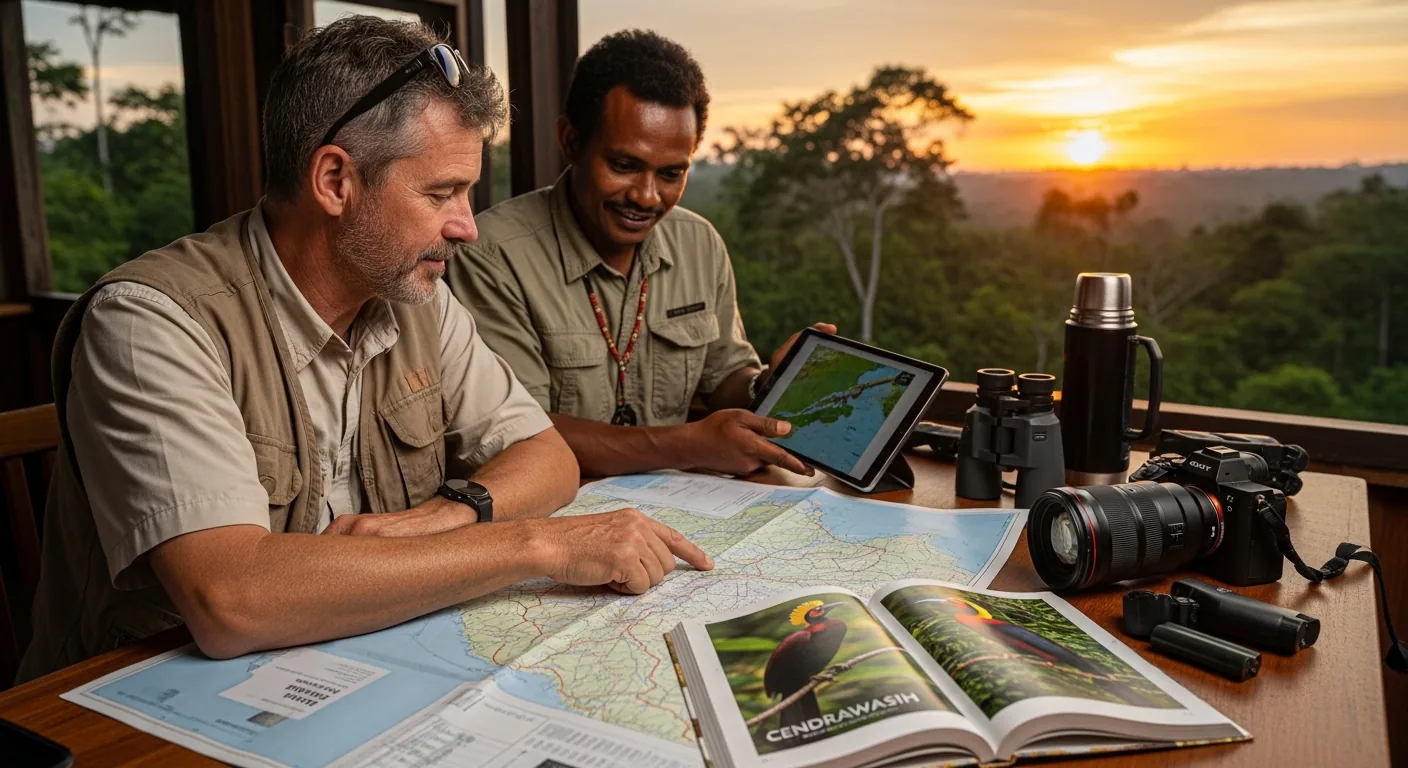
The air in the predawn forest of Waigeo is thick, a palpable humidity scented with damp earth and decaying leaves. Long before the sun breaches the canopy, the only light is the narrow beam of your headlamp, catching the iridescent flash of a beetle’s carapace or the ghost-white forms of fungi clinging to a fallen log. The silence is not an absence of sound, but a layering of it: the low thrum of insects, the distant, hollow call of a hornbill, the soft crush of your boots on the trail. Then, a new sound cuts through—a sharp, almost mechanical series of chirps and whistles. Your local guide, a man whose family has known this forest for generations, raises a hand. The lek is close. Through a screen of palms, you see it: a small patch of forest floor, swept meticulously clean of all debris. In a sliver of nascent light, a creature no larger than a starling begins its private ballet. A flash of impossible scarlet, a cap of brilliant turquoise-blue skin, and a flash of chrome yellow at the nape. This is Cicinnurus respublica, the Wilson’s Bird-of-Paradise, performing a ritual older than the island itself.
The Enigma of Cicinnurus respublica: A Photographer’s Pursuit
To witness the Wilson’s Bird-of-Paradise is to witness a marvel of evolutionary artistry. Formally described by Charles Lucien Bonaparte in 1850, this species remains one of the most sought-after sightings in the avian world. Its remote and restricted habitat, confined only to the forested hills of Waigeo and Batanta islands within the Raja Ampat archipelago of West Papua, has preserved its mystique. This is the authentic stage for any serious cendrawasih bird papua quest.
The male’s plumage is a catalog of startling contrasts. The vivid crimson back and wings give way to a rich yellow mantle on the upper neck. But the head is the true spectacle: a bare, cobalt-blue crown, traced with a delicate pattern of black lines, unique to each individual bird. Two finely coiled, violet tail feathers extend from its body, acting as sensitive instruments in its courtship display. Weighing a mere 53 to 67 grams and measuring just 16 centimeters in length, its visual impact is vastly disproportionate to its size. The female, by contrast, is a study in muted, olive-brown camouflage, a necessary adaptation for nesting safely on the forest floor. See also: explore Contact.
The forest floor is his stage. The single shaft of light, his spotlight. For the photographer, this is the decisive moment, measured in fractions of a second and rewarded with an image that transcends documentation. See also: the papua photography tour option.
It is crucial for the discerning traveler to distinguish this specific expedition from others in the region. While the Aru Islands are a celebrated birding destination, they are home to different endemics, such as the King Bird-of-Paradise (Cicinnurus regius). The phrase “Wilson’s Bird-of-Paradise Aru” is a common misnomer; the true and only location to observe and photograph this species is here, this specific raja ampat bird tour. Our expeditions are built around this geographical and biological reality, ensuring your efforts are directed at the correct location for this singular prize.
Your Private Expedition: Itinerary and Logistics
A successful expedition to view the Wilson’s Bird-of-Paradise is an exercise in precision, patience, and deep local knowledge. Our itineraries are designed to maximize opportunities at the lek during peak activity hours while minimizing our impact on the environment. This is a typical framework for a 7-day private expedition. See also: see Birds of Paradise Indonesia Expeditions’s Home.
Sample 7-Day / 6-Night Itinerary
- Day 1: Arrival in Sorong (SOQ) & Crossing to Waigeo
Upon arrival at Domine Eduard Osok Airport in Sorong, you will be met by a Birds of Paradise Indonesia Expeditions representative. We handle your luggage and transfer you to the port for the scheduled express ferry to Waisai, the administrative capital of Raja Ampat, located on Waigeo Island. The sea journey itself, approximately two hours, offers your first glimpse of the region’s iconic karst islands. In Waisai, you will be transferred by 4×4 vehicle to a simple yet comfortable eco-lodge, your base for the coming days. - Days 2-5: Lek Observation and Forest Exploration
Your days begin before 4:00 AM. After a light breakfast, you’ll a trek into the forest with your specialist guide and a local porter. The hike to the lek takes between 60 and 90 minutes over undulating, often muddy terrain. You will be situated in our purpose-built, concealed hide before sunrise. From here, you will wait, camera and binoculars ready, for the male to descend to his court. After the morning’s activity concludes, typically by 9:00 AM, you will trek back for a full breakfast. Afternoons can be spent exploring nearby trails for other species, such as the Red Bird-of-Paradise (Paradisaea rubra), or resting before the next early start. - Day 6: Final Observations & Return to Sorong
One final morning is dedicated to the Wilson’s lek, offering a chance to refine your photographs or simply absorb the spectacle without a lens. After returning to the lodge for breakfast and packing, you will be transferred back to Waisai to catch the afternoon ferry to Sorong. You will be checked into a comfortable hotel in Sorong for the night. - Day 7: Departure
After breakfast at the hotel, we will provide a timely transfer to Sorong’s airport for your onward flight.
Expedition Inclusions & Investment
We believe in transparent pricing and comprehensive service. Our focus is on providing a seamless logistical framework so you can direct your full attention to the wildlife. Every expedition is private and can be tailored to your specific interests and pace. See also: details on Arfak Mountains Birding.
What Is Included:
- A dedicated, expert English-speaking ornithological guide with extensive experience in West Papua’s avifauna.
- Access to and use of private, strategically placed photography hides at an active Wilson’s Bird-of-Paradise lek.
- All domestic logistics as per the itinerary: private airport transfers in Sorong, return express ferry tickets (VIP class) between Sorong and Waisai, and private 4×4 vehicle transport on Waigeo Island.
- Accommodation for 6 nights (4 nights in a Waigeo eco-lodge, 2 nights in a Sorong hotel).
- All meals during the expedition days on Waigeo, plus breakfast in Sorong. Bottled mineral water is provided throughout.
- All necessary permits, including the Raja Ampat Marine Park entrance fee (valid for one year) and local community access fees (surat jalan).
Private 7-day Wilson’s Bird-of-Paradise expeditions start from $4,850 USD per person (based on two travelers). The final investment can vary based on group size, season, and any requested customizations. Please contact us for a detailed proposal.
Photographing the Wilson’s Bird-of-Paradise: A Technical Brief
Photographing Cicinnurus respublica is a deeply rewarding challenge. The environment presents a trifecta of technical hurdles: extremely low light on the forest floor, the bird’s rapid, unpredictable movements, and the high-contrast scene when a sliver of sunlight does penetrate the canopy. Success requires the right equipment and technique.
Recommended Photographic Equipment:
- Camera Body: A full-frame or high-end APS-C camera with excellent high-ISO performance (e.g., capable of producing clean files at ISO 3200-12800).
- Lens: A fast telephoto lens is essential. An ideal choice is a 400mm f/2.8, 500mm f/4, or 600mm f/4. A 100-400mm or 200-600mm zoom can also be effective but may be challenged by the low light.
- Support: A sturdy tripod with a gimbal or fluid head is non-negotiable for stability and smooth movement within the confines of the hide.
- Accessories: Multiple batteries (there is limited charging capacity at the lodge), ample memory cards, a rain cover for your camera and lens, and a headlamp with a red-light mode for predawn treks.
Our guides are well-versed in the needs of photographers. They ensure the hide is positioned for the best possible light angle and background, and they enforce strict ethical guidelines. The welfare of the bird is paramount; use of flash is strictly prohibited, and movement and noise must be kept to an absolute minimum to avoid disturbing the natural courtship behavior.
| Location | Key Bird-of-Paradise Species | Terrain | Best Season |
|---|---|---|---|
| Raja Ampat (Waigeo/Batanta) | Wilson’s BoP, Red BoP | Lowland and hill rainforest, steep and muddy trails | May – October (Dry Season) |
| Arfak Mountains | Western Parotia, Arfak Astrapia, Magnificent BoP | Mid-montane to upper-montane forest, cool climate | June – November |
| Aru Islands | King BoP, Twelve-wired BoP, Greater BoP | Flat lowland rainforest, often waterlogged | May – October |
This table illustrates why a targeted approach is necessary. For those focused on the Wilson’s, a dedicated raja ampat bird tour is the only option, while a trip focused on arfak mountains birding yields an entirely different set of species in a contrasting environment.
Planning Your Cendrawasih Expedition: Frequently Asked Questions
We understand that a trip to West Papua requires careful planning. Below are answers to common questions from our prospective clients.
What is the best time of year to see the Wilson’s Bird-of-Paradise display?
The birds display year-round, but the prime viewing season coincides with West Papua’s drier months, typically from May through October. During this period, the forest trails are more manageable, and there is a higher probability of clear mornings, which provides better light for observation and photography.
How physically demanding is the trek to the lek?
A good level of physical fitness is required. The daily treks to the hide are between 4 and 6 kilometers round-trip. The trails are not paved; they are often steep, uneven, and can be very slippery and muddy, especially after rain. The hikes are undertaken in high humidity and darkness. We recommend clients have experience with rigorous hiking.
What are the accommodation arrangements like?
To access the remote forest habitat, we utilize the best available local accommodations. These are typically simple, clean eco-lodges or homestays managed by the local community. Rooms have basic amenities, often with shared bathroom facilities and limited electricity (usually from a generator for a few hours in the evening). This approach ensures an authentic connection to the place and that your visit directly benefits the local land custodians.
Is this expedition suitable for non-photographers?
Absolutely. While the logistics are structured to accommodate the needs of serious photographers, the primary goal is the observation and appreciation of this incredible species. The experience of sitting silently in a hide, watching the male perform his elaborate dance just meters away, is profound. A quality pair of binoculars (e.g., 8×42 or 10×42) is as essential as a camera.
What conservation efforts does this trip support?
Birds of Paradise Indonesia Expeditions is committed to sustainable, conservation-based tourism. A significant portion of your expedition fee is paid directly to the local land-owning families for the protection of the lek and surrounding forest. This provides a powerful economic incentive for conservation, creating a viable alternative to logging or mining. By joining our expedition, you are directly contributing to the preservation of the cendrawasih bird papua and its habitat.
Secure Your Place with Birds of Paradise Indonesia Expeditions
Our expeditions are meticulously planned and privately run, ensuring an intimate and focused wildlife encounter. Due to the limited capacity of the hides and our commitment to low-impact tourism, we recommend booking at least 6 to 12 months in advance, especially for the peak season.
Booking Process:
- Initial Inquiry: Contact our expedition planning office by email at [email protected] or by phone/WhatsApp at +62 811 3941 4563. Please provide your preferred travel dates, the number of people in your party, and your primary interests (e.g., photography, videography, observation).
- Personalized Consultation: Our team will follow up to schedule a call. This allows us to understand your photographic objectives, assess physical fitness levels, and answer any detailed questions you may have. We then craft a tailored itinerary and proposal.
- Confirmation & Deposit: Upon your approval of the proposed itinerary, a deposit will secure your dates, your specialist guide, and all necessary permits and local arrangements.
- Pre-Departure Preparation: You will receive a comprehensive pre-departure package from us. This includes a detailed gear and clothing list, visa and travel insurance information, a medical guide, and a cultural briefing to prepare you for your time in West Papua.
We look forward to guiding you to one of the world’s most extraordinary avian spectacles. Our Bali office is located at Jalan Sunset Road No. 88, Kuta, Badung, Bali 80361, Indonesia.
Explore Other West Papua Expeditions
- Arfak Mountains Birding: The Home of the Parotias
- The Aru Islands: In Search of the King and Greater BoP
- West Papua Cendrawasih: A Comprehensive Tour