Raja Ampat Bird Tour: Wilson’s & Red Bird-of-Paradise | Birds of Paradise Indonesia
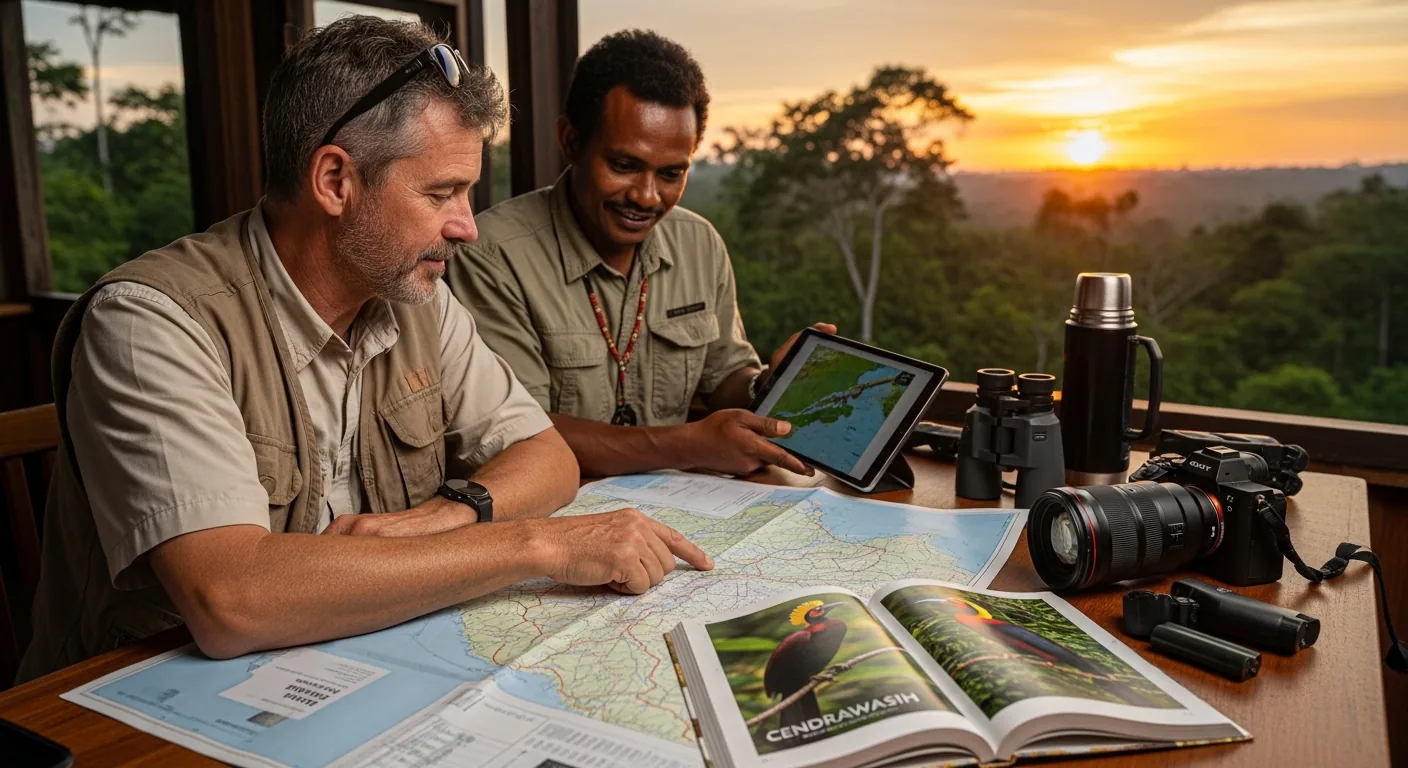
The air is thick, a palpable weight of humidity and sound. Long before the sun breaches the horizon over the Dampier Strait, the Waigeo rainforest awakens. A low hum of a million insects forms the baseline, punctuated by the resonant call of a distant Western Crowned Pigeon. You move in near silence, the damp leaf litter compressing underfoot. Your guide, a man whose family has known these trails for generations, points to a specific clearing on the forest floor, barely 15 meters away. The darkness is still absolute, but here, in this meticulously maintained arena, a spectacle is about to unfold. This is the overture to observing the most coveted of the cendrawasih bird papua; this is the start of your Raja Ampat bird tour.
The Twin Jewels of Waigeo: An Expedition into Avian Royalty
The islands of Raja Ampat, an archipelago of over 1,500 karst spires and emerald jungle west of New Guinea, are a global epicenter of marine biodiversity. Yet, within the dense forests of its largest island, Waigeo, and its satellite, Batanta, reside two of ornithology’s most enigmatic and visually arresting species: the Red Bird-of-Paradise (Paradisaea rubra) and the Wilson’s Bird-of-Paradise (Cicinnurus respublica). To witness both is to achieve a rare distinction in wildlife observation.
This is not a conventional tour. It is a focused, patient expedition designed for the discerning naturalist, ornithologist, and photographer. Our approach eschews large groups and rushed schedules, prioritizing instead the quiet, methodical process required to observe these birds engaging in their natural courtship displays. The Red Bird-of-Paradise, with its cascading crimson plumes, performs a ballet high in the canopy. In stark contrast, the Wilson’s Bird-of-Paradise, famously described by Alfred Russel Wallace in 1860 as a “gem of the highest order,” clears a personal stage on the forest floor, a creature of iridescent turquoise, cobalt, and scarlet so vibrant it appears synthetic. Our deep-rooted connections with local communities in villages like Saporkren provide access to protected display sites, ensuring your presence contributes directly to their preservation. See also: our Best Time Bop Papua.
“Observing the Wilson’s Bird-of-Paradise at its lek is less a viewing and more an audience. The bird is the artist, the forest floor its canvas. It is a moment of profound, quiet intensity that redefines one’s understanding of natural selection.” See also: Contact pricing.
A Curated Expedition: Inclusions & Logistics
Birds of Paradise Indonesia Expeditions manages every detail to ensure your focus remains entirely on the avian life before you. We operate on a principle of transparent, comprehensive planning. Your expedition includes: See also: Birds of Paradise Indonesia Expeditions.
- Expert Local Ornithological Guide: A dedicated Papuan guide with intimate knowledge of the birds’ territories, calls, and behaviors, for the entire duration of your tour.
- Private Transportation: All logistical movements are covered, including airport transfers in Sorong, fast ferry tickets from Sorong to Waisai (the capital of Raja Ampat Regency), and private longboat charters for inter-island travel.
- Accommodation: Carefully selected lodging on Waigeo Island, ranging from comfortable, locally-owned homestays to dedicated eco-resorts, based on your preference and itinerary.
- All Necessary Permits: We secure the Raja Ampat Marine Park entry permit (known as the KJLPL tag) and any required local community access fees for the birding sites.
- Meals and Provisions: All meals (breakfast, lunch, dinner) and ample bottled water are provided throughout the expedition. We can accommodate specific dietary requirements with advance notice.
The Rhythm of the Search: A Sample 5-Day Itinerary
The pursuit of birds-of-paradise follows a distinct rhythm, dictated by the dawn and dusk display times. This sample itinerary for a raja ampat bird tour illustrates the focused pace of the expedition.
Day 1: Arrival in Sorong (SOQ) and Passage to Waigeo
Upon your morning arrival at Domine Eduard Osok Airport in Sorong, our representative will greet you. We transfer to the ferry terminal for the 09:00 AM express ferry to Waisai, a journey of approximately two hours across the Dampier Strait. In Waisai, you will be met by your private boat and guide for the final transfer to your accommodation on Waigeo’s southern coast. The afternoon is for settling in, equipment preparation, and a briefing on the days ahead. See also: the bop aru islands option.
Day 2: The Forest Floor Stage of Wilson’s Bird-of-Paradise
04:30: An early start with coffee and a light snack. We travel by boat or 4×4 vehicle to the trailhead for the Wilson’s Bird-of-Paradise lek.
05:15: A trek of 45-60 minutes, often in darkness, brings us to the hide. Silence is paramount.
06:00 – 08:30: The prime activity window. We observe the male as he meticulously clears his court and performs his electrifying display for visiting females.
09:00: Return to the lodge for a full breakfast. The remainder of the day can be spent exploring the local village, snorkeling the house reef, or searching for other forest species like the Western Crowned Pigeon and various kingfishers.
Day 3: The Canopy Ballet of the Red Bird-of-Paradise
05:00: Another pre-dawn start, this time targeting a known lekking tree for the Red Bird-of-Paradise. The approach is slightly different, focusing on a position with a clear view of the high canopy.
06:00 – 09:00: From our vantage point, we watch as multiple males congregate, calling and performing their inverted display, shaking their magnificent red plumes. The social dynamics of the lek are a key focus.
Afternoon: We can opt for a second viewing in the late afternoon, as activity sometimes resumes before dusk, or explore the mangroves by boat for other coastal and forest-edge species.
Day 4: Photographic Opportunities & Sister Species
This day is flexible, built around your specific interests. We can return to either hide to improve photographic opportunities or to simply re-witness the displays. Alternatively, we can take a boat to nearby Gam Island to search for its population of Red Birds-of-Paradise or explore different habitats on Waigeo for a wider variety of the region’s 320+ recorded bird species.
Day 5: Departure from the Last Eden
After a final Papuan breakfast, we transfer by private boat back to Waisai to connect with the morning ferry to Sorong. Our team will then transfer you to Sorong’s airport for your onward flight, concluding your expedition with Birds of Paradise Indonesia Expeditions.
Wilson’s & The Red: A Comparative Study in the Field
While sharing the same island, these two species offer entirely different observation challenges and rewards. Understanding their distinctions is key to appreciating the expedition. This is a core component of our specialized raja ampat bird tour.
| Attribute | Wilson’s Bird-of-Paradise (Cicinnurus respublica) | Red Bird-of-Paradise (Paradisaea rubra) |
|---|---|---|
| Habitat Preference | Primary and secondary lowland and hill forest, typically below 300 meters. | Lowland and hill forest, often at the forest edge and in taller canopy, up to 600 meters. |
| Display Type | Solitary terrestrial court (lek) on the forest floor, meticulously cleared by the male. | Communal arboreal lek in a specific treetop, with multiple males displaying together. |
| Viewing Proximity | Excellent. Hides are typically placed 10-20 meters from the court, offering eye-level views. | Challenging. Viewing is from the ground, looking up into the canopy, often 30-40 meters high. |
| Primary Activity | Early morning (06:00 – 08:30) is most reliable. The court is the sole focus of activity. | Early morning (06:00 – 09:00) and sometimes late afternoon. Males move between branches. |
| Photographic Challenge | Low light on the forest floor requires high ISO and fast lenses. Proximity is an advantage. | Harsh backlighting against the sky is common. Requires long focal lengths (600mm+). |
Your Investment in Rarefied Nature: Tour Pricing
We believe in transparent pricing tailored to the specific logistics of your expedition. The cost is influenced by the level of accommodation, the number of participants, and the duration of the tour.
Private Raja Ampat Birding Expeditions start from $2,950 USD per person (based on two people sharing for a 5-day/4-night itinerary). This includes all permits, private guiding, standard accommodation, meals, and all transport ex-Sorong. Pricing for solo travelers, small groups, or those requesting upgraded resort accommodation is available upon request. Please contact us for a detailed, customized proposal.
Field Notes: Answering Your Expedition Questions
Preparing for an expedition to West Papua involves unique considerations. Here are answers to common questions from our clients.
What level of physical fitness is required?
A moderate level of fitness is necessary. The hikes to the hides are not long (typically under one hour) but can be steep and slippery, especially after rain. The primary challenge is the heat and high humidity of the equatorial climate. You should be comfortable walking on uneven forest trails in these conditions.
What camera gear is recommended for this tour?
For photographers, we recommend a DSLR or mirrorless camera body with good low-light performance. For Wilson’s BoP, a lens in the 70-200mm or 100-400mm range is often sufficient due to the proximity of the hides. For the Red BoP in the canopy, a 500mm or 600mm lens (or a 400mm with a teleconverter) is highly advantageous. A tripod is essential for the low-light conditions at the Wilson’s lek.
How does this tour support conservation and local communities?
Birds of Paradise Indonesia Expeditions operates on a foundation of ethical ecotourism. A significant portion of your tour fee goes directly to the local land-owning families who protect the bird-of-paradise leks. By providing a sustainable income from tourism, we create a powerful economic incentive to preserve the forest habitat against logging and poaching. Our guides are all from the local Papuan community, ensuring your investment remains within the region.
Is this a private or group tour?
All our expeditions are arranged on a private basis. We do not combine groups. This ensures maximum flexibility in the field, allowing us to adapt the itinerary to your specific interests, pace, and photographic goals. It also minimizes disturbance at the sensitive birding sites.
What is the best season for a Raja Ampat bird tour?
Birding is excellent year-round as the birds are non-migratory and display throughout the year. However, the driest season generally runs from October to April, offering more comfortable trekking conditions and a higher number of sunny days. The shoulder months can also be very productive with fewer visitors.
Led by Experts, Rooted in Conservation
Our distinction lies in our guides. They are not simply tour leaders; they are custodians of an ancient ecological knowledge. Guides from Waigeo have learned the language of the forest from their fathers and grandfathers. They can identify the cendrawasih bird papua not just by sight, but by the subtle snap of a twig or a faint territorial call carried on the morning air. This deep, instinctual connection cannot be taught; it is lived. By choosing Birds of Paradise Indonesia Expeditions, you are not just hiring a guide; you are gaining access to this lineage of expertise and contributing to its continuity.
Securing Your Place: The Booking Process
Booking your specialized expedition is a straightforward, consultative process. We ensure every detail is aligned with your objectives before you commit.
- Initial Inquiry: Contact us via email at [email protected] or by phone/WhatsApp at +62 811 3941 4563 with your desired travel dates and interests.
- Itinerary Customization: Our expedition specialist will work with you to craft a personalized itinerary, discussing accommodation options, tour duration, and any specific target species.
- Confirmation & Deposit: Once you approve the detailed proposal, we will issue an invoice for a deposit to secure your guide and logistical arrangements.
- Pre-Departure Briefing: In the weeks leading up to your trip, we provide a comprehensive pre-departure package with a detailed packing list, gear recommendations, and cultural information to ensure you are fully prepared.
Our administrative office is located at Jalan Sunset Road No. 88, Kuta, Badung, Bali 80361, Indonesia.
Beyond Raja Ampat: Sister Sites in the Cendrawasih Realm
The islands of Waigeo and Batanta offer a magnificent introduction to the birds-of-paradise, but they are just one chapter in the story of West Papua’s avian diversity. For the dedicated ornithologist, we offer expeditions to other legendary birding locales, each presenting a unique suite of species and habitats.
Consider combining your Raja Ampat tour with an expedition into the Arfak Mountains birding highlands near Manokwari. Here, the cool, moss-draped cloud forests are home to a completely different set of Paradisaeidae, including the Western Parotia, Magnificent Bird-of-Paradise, and the Long-tailed Paradigalla. The experience is one of high-altitude trekking and hide-based observation for species found nowhere else on earth.
For those tracing the footsteps of natural history’s pioneers, an expedition to the Aru Islands is essential. While our tours focus on the more accessible Waigeo population of Wilson’s, the historical context of wilson’s bird of paradise aru is profound, as this is where Wallace’s collectors first secured specimens. The Aru Islands also host the Greater Bird-of-Paradise, the species that launched the entire European fascination with these birds. Each location—Raja Ampat, Arfak, Aru—is a critical piece of the cendrawasih bird papua puzzle, and we are uniquely positioned to guide you through them all.