Arfak Mountains Birding with Birds of Paradise Indonesia: A Guide to the Western Parotia & Vogelkop Bowerbird
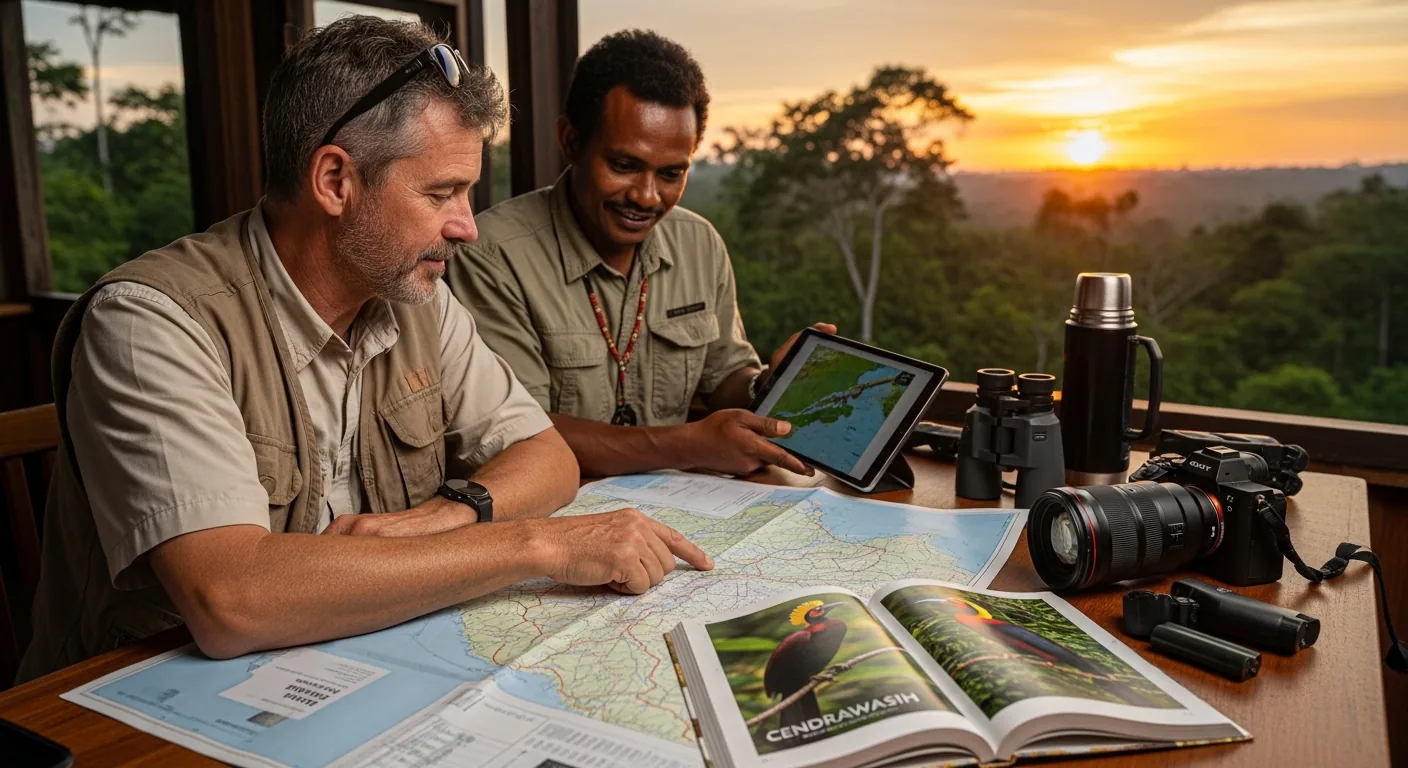
The air is thin, cool, and carries the scent of damp moss and decaying leaves, a primal perfume that clings to the pre-dawn darkness. At 1,900 meters in the Arfak Mountains of West Papua, the world is reduced to sound and shadow. A faint rustle in the undergrowth. The distant, resonant call of a Magnificent Bird-of-Paradise, a sound that seems to vibrate in your very bones. You sit motionless in the hide, a simple structure of palm leaves, the camera cold in your hands. This is not a spectator sport; it is an act of immersion, a patient vigil on one of Earth’s most exclusive stages. This is the essence of an Arfak Mountains birding expedition, a focused pursuit of the avian wonders, the cendrawasih, that have made this remote corner of Indonesia a near-mythical destination.
For ornithologists, dedicated wildlife photographers, and discerning eco-tourists, the Arfak range on the Bird’s Head Peninsula is a singular objective. It is a vertical island of biodiversity, rising to 2,955 meters at the peak of Mount Arfak, harbouring a concentration of endemic species found nowhere else. This is the domain of the Vogelkop Superb Bird-of-Paradise, the Arfak Astrapia, and the architects of the avian world, the bowerbirds. Birds of Paradise Indonesia Expeditions curates private, guide-led explorations into this montane forest, focusing on respectful, sustainable observation that directly benefits the local Hatam and Sough communities who are the ancestral custodians of these grounds. See also: bop species guide.
The Arfak Highlands: A Singular Stage for Avian Theater
The isolation of the Arfak Mountains has fostered an extraordinary degree of endemism. This is not simply a location for birdwatching; it is a living laboratory of evolution. Our expeditions are based out of rustic, community-owned guesthouses in villages like Siyoubri and Mokwam, situated at elevations between 1,600 and 1,900 meters. This strategic positioning provides direct access to the specific altitudinal zones required by the most sought-after species. The terrain is challenging, with daily treks along narrow, often steep forest trails. The reward for this effort is entry into a world governed by ancient rhythms of display and courtship. See also: Wilsons Bop Aru Islands guide.
The approach to observing the famed cendrawasih bird papua here is one of patience and minimal disturbance. We utilize purpose-built hides, known locally as ‘honai’, which are strategically placed near the display courts and perches of key species. These hides, constructed from natural materials by our local partners, allow for close-range observation and photography without stressing the birds. The entire ecosystem, from the forest floor to the canopy, is alive. While the birds-of-paradise are the primary focus, the Arfaks are also home to a suite of other montane specialists, including the White-striped Forest Rail, Vogelkop Melidectes, and several species of robins and berrypeckers, making every moment in the field a discovery.
“Our guides, men from the Hatam and Sough tribes, don’t just find the birds; they interpret their behavior, a skill passed down through generations in the Arfak Mountains. They read the forest like a text, understanding the subtle cues that precede a display.” See also: Contact pricing.
The Choreography of the Cendrawasih: Key Species of the Arfaks
An Arfak Mountains birding tour is defined by its iconic avian residents. While the list of potential sightings is long, three species in particular form the core of the experience, each offering a unique spectacle of natural selection at its most flamboyant. See also: Birds of Paradise Indonesia Expeditions Home.
The Western Parotia (Parotia sefilata): The Ballerina Bird
First described for science by Pieter Boddaert in 1783, the Western Parotia is perhaps the most charismatic performer of the Arfaks. The male, a study in velvety black, is distinguished by six wire-like plumes tipped with spatules that spring from behind his head. His performance takes place on a meticulously cleared patch of forest floor, his ‘court’. Before his dance, he fastidiously removes every leaf and twig. The display itself is a complex sequence of movements, often called the ‘ballerina dance’, where he spreads his flank feathers into a skirt-like shape and bobs and pivots, causing his head wires to sway hypnotically. Observing this ritual from a nearby hide at dawn is a foundational West Papua birding moment.
The Magnificent Bird-of-Paradise (Diphyllodes magnificus)
Smaller but no less spectacular, the Magnificent Bird-of-Paradise performs on a sapling stage. The male is a jewel-box of color: an iridescent green breast shield, a sulfur-yellow cape, and two long, sickle-shaped tail wires. He spends his days clearing the leaves from around his preferred display perch, waiting for the arrival of a female. His display is an energetic series of postures, puffs, and calls, designed to show off every facet of his plumage. The specific, almost predictable nature of his display area makes him a prized subject for photographers, offering a chance to capture one of the most vibrant members of the Paradisaeidae family.
The Vogelkop Bowerbird (Amblyornis inornata): An Avian Architect
The Vogelkop Bowerbird presents a fascinating paradox. The bird itself is remarkably plain—a drab, olive-brown creature that would easily be overlooked. Its genius, however, lies not in its plumage but in its architecture. The male constructs a large, cone-shaped bower, a maypole-like structure of sticks woven around a central sapling, complete with a mossy lawn. He then meticulously decorates this structure and its surroundings with objects sorted by color. Piles of bright blue berries, iridescent beetle carapaces, yellow flowers, black fungi, and even colorful pieces of discarded plastic are arranged in distinct, curated collections. Each bower is a unique creation, an aesthetic statement built to attract a mate. Finding one of these bowers is like discovering a secret art installation deep in the forest, a cognitive complexity that challenges our understanding of animal intelligence.
Your Arfak Mountains Birding Expedition: A Structured Approach
A successful expedition into this remote region requires meticulous planning and deep local integration. Birds of Paradise Indonesia Expeditions provides an all-inclusive, ground-level service that handles the complex logistics, allowing you to focus entirely on the avian world around you. Our private tours are tailored to the pace and specific interests of our guests, whether the priority is a comprehensive species list or dedicated photographic opportunities.
What’s Included in Your Private Expedition:
- Expert Local Guiding: One-on-one guidance from our seasoned Arfak birding specialists from the local Hatam community.
- Logistics and Transport: Round-trip 4×4 vehicle transport from Manokwari (NOK) to the Arfak Mountain highlands.
- Accommodations: Stays in simple, clean, community-run guesthouses in Siyoubri or similar villages, providing an authentic local experience.
- Meals and Provisions: All meals (breakfast, lunch, dinner) and bottled water prepared by our local team in the mountains.
- Permits and Access: All necessary travel permits (Surat Jalan), conservation fees, and payments for access to bird-of-paradise hides.
Sample 5-Day / 4-Night Itinerary Outline:
Day 1: Arrival and Ascent. Your guide meets you at Manokwari’s Rendani Airport (NOK). After provisioning, you begin the 3-4 hour 4×4 journey up into the Arfak Mountains, climbing to your guesthouse at approximately 1,800 meters. Settle in and prepare for an early start.
Day 2: The Western Parotia. A pre-dawn (approx. 4:30 AM) trek of 45-60 minutes to the Western Parotia hide. You will spend the morning observing and photographing the male’s courtship display. In the afternoon, a guided walk to search for the Vogelkop Bowerbird’s intricate constructions.
Day 3: Magnificent BoP & Montane Exploration. Another early start to visit the display court of the Magnificent Bird-of-Paradise. The afternoon is dedicated to searching for other Arfak endemics, such as the Arfak Astrapia or Black-billed Sicklebill, depending on recent sightings and your physical condition.
Day 4: Additional Targets & Cultural Immersion. This day is flexible. You may choose to revisit a hide for better photographic conditions or trek to a different area for new species like the Vogelkop Superb Bird-of-Paradise. Time is also spent interacting with your host community, understanding the local culture that is intertwined with the cendrawasih.
Day 5: Descent and Departure. After a final morning of birding near the guesthouse, you will descend back to Manokwari for your onward flight from NOK or to continue to another destination, such as a Raja Ampat bird tour.
Expedition Logistics and Comparative Planning
Understanding the specifics of an Arfak expedition is key to a rewarding trip. Our private itineraries are designed for 2-4 guests to ensure a low-impact and personalized experience. Pricing for our fully-inclusive 5-day/4-night private Arfak Mountains birding expedition starts from $2,150 USD per person (based on two people sharing).
To help you decide which West Papua destination best suits your objectives, consider the following comparison:
| Destination | Key Cendrawasih Species | Physical Difficulty | Best Season | Accommodation Style |
|---|---|---|---|---|
| Arfak Mountains | Western Parotia, Magnificent BoP, Vogelkop Bowerbird, Arfak Astrapia | High (steep, muddy trails) | June – October (drier season) | Basic community guesthouse |
| Aru Islands | King Bird-of-Paradise, Twelve-wired Bird-of-Paradise, Greater Bird-of-Paradise | Moderate (hot, humid, flat) | May – September | Basic local homestay / chartered boat |
| Raja Ampat (Waigeo/Batanta) | Wilson’s Bird-of-Paradise, Red Bird-of-Paradise | Moderate to High (short, steep climbs) | October – April | Eco-resort or homestay |
Planning Your West Papua Cendrawasih Tour: Frequently Asked Questions
Navigating a trip to this part of the world involves specific considerations. Here are answers to common questions from our clients.
What is the physical difficulty of an Arfak Mountains birding tour?
A high level of fitness is required. Daily treks to hides can take 30-90 minutes each way on trails that are often steep, uneven, and can be very slippery and muddy, especially after rain. You must be comfortable with hiking in challenging conditions at altitude.
What is the best time of year to visit?
The drier season, typically from June to October, is ideal. While rain is possible year-round in the mountains, this period generally offers more stable weather, clearer trails, and consistent bird activity.
What camera gear is recommended for photographers?
The forest is dark. A full-frame camera with good low-light performance is highly recommended. A lens with a reach of at least 400mm (a 100-400mm or 200-600mm zoom is versatile) is essential. A sturdy tripod is a necessity for the low-light conditions inside the hides. Flash is strictly prohibited as it disturbs the birds.
What are the accommodations like?
Accommodations are basic but clean. Expect a simple wooden guesthouse with private rooms, mattresses on the floor with bedding, and shared toilet facilities (mandi-style). There is limited to no electricity or mobile signal, offering a true disconnect from the outside world.
How does this expedition support local communities?
Our operational model is built on community-based ecotourism. A significant portion of your expedition fee goes directly to the local Hatam and Sough families who own the land, operate the guesthouses, work as our guides and porters, and maintain the bird hides. This creates a direct economic incentive for the conservation of the forest and its unique cendrawasih bird papua populations.
Securing Your Place: The Booking Process
Booking your specialized Arfak expedition with Birds of Paradise Indonesia Expeditions is a straightforward, consultative process. We ensure every detail is aligned with your expectations before you arrive in West Papua.
- Initial Inquiry: Contact our expedition planner via email at [email protected] or by phone/WhatsApp at +62 811 3941 4563 with your desired dates and group size.
- Consultation & Itinerary Design: We will discuss your specific interests (e.g., photography focus, target species list) and physical fitness to craft a personalized daily itinerary.
- Confirmation & Deposit: Once the itinerary is finalized, we will provide a detailed proposal and invoice. A deposit secures your dates and our guiding team.
- Pre-Trip Briefing: You will receive a comprehensive pre-departure package containing a detailed packing list, logistical information, and cultural guidelines to prepare you for your adventure in the Arfak Mountains.
Our main office is located at Jalan Sunset Road No. 88, Kuta, Badung, Bali 80361, providing a stable logistical hub for all our Indonesian operations.
Explore Further: Other Endemic Frontiers in West Papua
The Arfak Mountains are just one chapter in the incredible story of West Papua’s biodiversity. For those wishing to witness the full spectrum of the Paradisaeidae family, we also arrange expeditions to other remote hotspots. Consider extending your travel to include the lowland forests of the Aru Islands to seek out the magnificent court of the Wilson’s Bird of Paradise in Aru, or join a Raja Ampat bird tour to combine world-class snorkeling and diving with the quest for the iconic Red Bird-of-Paradise on Waigeo Island. Each destination offers a completely different environment and a new cast of avian characters, completing a comprehensive survey of this remarkable region.